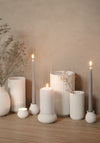
A stripe travels around a rounded vase. A groove catches the light beneath a pale glaze. A bowl becomes more interesting when you turn it in your hands. Kähler’s character often lives in the meeting between the shape of an object and the treatment of its surface.
The Danish ceramics brand has been developing that conversation since 1839. Its history brings together potters, painters, sculptors, and designers, each adding a different idea to the possibilities of clay. That collective spirit gives the familiar pieces in today’s collection a story that reaches far beyond their place on a shelf.

The Workshop That Drew Artists to Næstved
Herman J. Kähler opened a ceramics workshop in Næstved in 1839. His son, Herman A. Kähler, took over in 1875 and helped turn the family business into a place known for artistic ceramics and experimentation. The workshop’s history developed through the relationship between technical skill and the ideas of the artists who joined it.
Herman A. Kähler’s interest in glazes was particularly important. Danish biographical accounts describe his experiments with colored glazes and metallic lustres, including a red copper lustre used on sculptural vases by Karl Hansen Reistrup. The finish gave the ceramic surface a distinctive presence, making material experimentation part of the artistic result.
The work reached an international audience through exhibitions, including the Paris world exhibition in 1889. That recognition places the Næstved workshop within a much wider history of decorative arts. A local ceramics business was contributing objects to the international conversation about art and craft.
Artists including Thorvald Bindesbøll, Svend Hammershøi, and Kai Nielsen worked within Kähler’s creative world. Their different approaches helped establish a brand identity built through collaboration. Clay could become a useful household object, a sculptural form, or a surface for an artist’s expression.
That variety is an important part of the story. Kähler’s heritage contains several creative voices. The workshop offered a shared setting in which those voices could meet the knowledge of people who understood the material, the glaze, and the firing process.

Kähler’s ceramic heritage
The Hammershøi Name Then and Now
The Hammershøi collection gives a clear example of how Kähler’s archive continues to inspire design. Svend Hammershøi was a historic collaborator whose work became associated with distinctive profiles and grooves. The modern collection bearing his name was designed by Hans-Christian Bauer, drawing inspiration from that earlier artistic language.
That connection is best understood as a conversation across time. Hammershøi’s work supplies a point of reference, and Bauer develops it for a contemporary family of objects. The current pieces carry the influence of the archive through a new designer’s decisions.
The grooves provide a shared rhythm. On a vase, they emphasize the volume and the curve. Across tableware, the repeating relief links pieces with different tasks. A cup, bowl, and plate can feel related through the same treatment of the surface.
That is one reason the collection can be appreciated at several distances. From across a room, a vase has a clear outline. Up close, the surface offers another layer of interest. At a table, the repeating detail provides a connection between individual pieces.
Hammershøi also shows how a historic name can introduce a current design without obscuring its authorship. Svend Hammershøi belongs to the earlier chapter; Hans-Christian Bauer shaped the modern series. Learning both names makes the relationship more meaningful.
There is a particular pleasure in seeing a relief continue around a curved surface. The rhythm changes with the angle of view, becoming compressed near an edge and more open across the front. A single-color glaze makes those changes easy to notice. The decoration is already present in the form; light brings different parts of it forward throughout the day.

Omaggio and the Personality of a Painted Stripe
Omaggio offers a different expression of Kähler. Created with Stilleben and introduced in 2008, the collection is recognized for the hand-painted stripes that travel around its rounded forms. The design duo brings together Ditte Reckweg and Jelena Schou Nordentoft, whose work also extends to other Danish design collaborations.
A stripe is a simple motif, but its relationship with the vase gives it character. The bands follow the volume of the object, emphasizing where it widens and narrows. Repetition makes the pattern easy to recognize, while the painted surface keeps the process part of what you see.
The vase becomes especially lively when filled with flowers. Stems and petals introduce irregular lines above the regular bands. The shape beneath them gives the arrangement a clear foundation, while the color of the stripes can connect with the flowers or the room around it.
This is another way to see the workshop tradition in contemporary form. With Hammershøi, the relief supplies the rhythm. With Omaggio, the painted decoration supplies it. The collections arrive at different visual identities through the same close attention to surface and shape.
Omaggio’s straightforward motif also makes the craft easy to appreciate. The stripe becomes a trace of the process, a visible part of how the object gained its personality. You encounter the design through something familiar, then begin to notice the decisions inside it.

Omaggio stripes and the HAK signature
A Continuing Place for Art in Everyday Life
Kähler became part of Rosendahl Design Group in 2018. Its current creative world includes designers and artists such as Hans-Christian Bauer, Stilleben, Meyer-Lavigne, and Rikke Jacobsen. The names change across generations, while collaboration remains a recurring part of the brand’s approach.
That continuity gives the company room to develop. A ceramic archive can be interpreted through a new shape, palette, or kind of object. A familiar motif can appear in another setting. The historic work becomes a resource for creative decisions made now.
For the person choosing an object, the connection is immediate. A vase changes how a bouquet occupies the room. A cup adds a particular surface to a morning routine. A bowl can contribute both its useful volume and its visual character to a table.
At BrandsWalk, Kähler interests us because the artistic history remains present in practical things. The brand can introduce a household to an artist’s name through a vase or a collection of tableware. What begins as an attractive object becomes a way to discover a broader creative world.
The story starts in a nineteenth-century workshop, where potters and artists explored what clay could become. It continues in the modern collection through grooves, painted bands, and new collaborations. Then it reaches the home, where a chosen piece begins to take part in someone else’s daily life.
A flower arrangement, a shared meal, or a favorite shelf gives the object its next setting. The surface still carries the design, but the experience becomes personal. That is the lasting appeal of Kähler’s artistic spirit.